[vc_row css=”.vc_custom_1721227091827{margin-top: 50px !important;margin-bottom: 50px !important;}”][vc_column][vc_column_text css=”.vc_custom_1759516860210{margin-top: 30px !important;margin-bottom: 30px !important;}”]
[/vc_column_text][vc_column_text]
AI Safety Must Include the Global South’s Food Systems
Author: Walamatien Coulibaly
Date: October 2, 2025

Lead
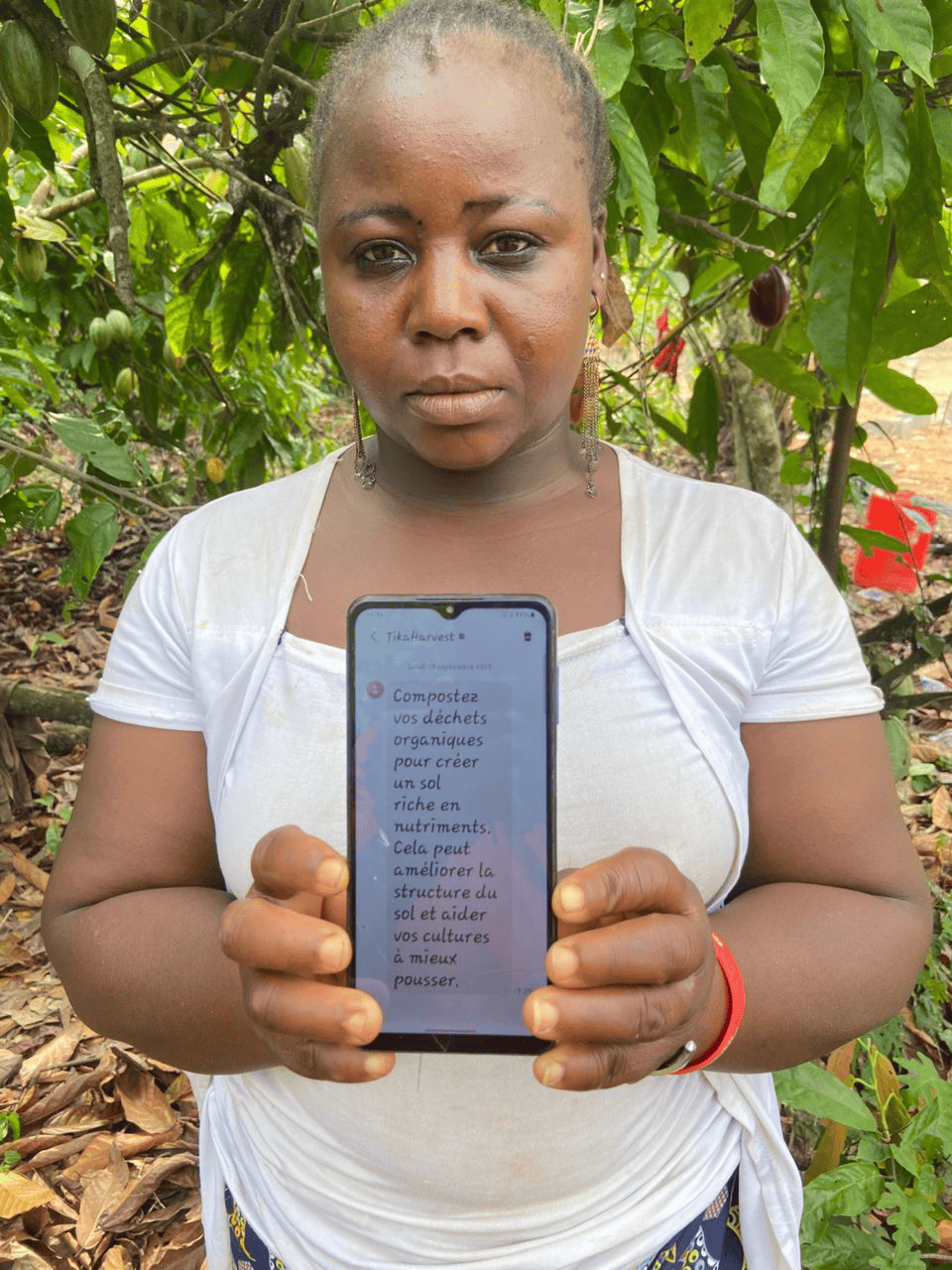
In Côte d’Ivoire, a farmer can receive a 160-character message that reshapes an entire season. Plant today or wait. Spray now or hold. Take a loan or skip inputs. When AI helps compose that message, safety is no longer academic—it is the difference between resilience and loss.
The Blind Spot
Much of today’s AI governance was written for high-bandwidth apps and well-resourced users. Our work at Mita Project is different. We partner with cooperatives and extension agents, and we incubated TikaHarvest to deliver climate-smart advisories via SMS/USSD. Our users are brilliant farmers; many are also navigating low literacy, shared phones, and weak safety nets. In this context, a confident but wrong instruction is not a minor bug—it’s a failed harvest.
A Field-Tested View of Risk
- Advice without uncertainty invites overconfidence. Farmers deserve probability ranges and plan-B options.
- Chemical guidance must never guess. If labels or stages are uncertain, refuse and escalate.
- Localization matters: small phrasing changes in French can flip a dose or timeline.
- Data drift happens: new pests or weather patterns can invalidate yesterday’s advice.
Five Rules for Safer Deployment (That We Now Use)
- Human-in-the-loop, by design: Route edge cases to extension agents; publish SLAs for callbacks.
- Uncertainty upfront: Use “ranges, not decrees” when forecasts straddle thresholds.
- Multilingual, readable prompts: Short sentences; explicit units; examples.
- Safemode templates: If risk flags trip, switch to curated, conservative messages.
- Community escalation: A simple keyword—“ALERTE”—should trigger a human review and fast follow-up.
What Policymakers Can Do in 12 Months
- Pilot certification for agricultural AI with independent red-teams and incident disclosure.
- Tie procurement (donors, ministries) to safety telemetry and rollback plans.
- Fund extension services as the human backstop for AI uncertainty.
What Labs Can Do in 90 Days
- Open test libraries for ag-specific harms (chemical safety, irrigation, finance).
- Ship uncertainty patterns and refusal templates developers can reuse.
- Add low-bandwidth telemetry toggles so SMS/USSD deployments aren’t blind.
What Cooperatives & NGOs Can Do Next Season
- Stand up farmer panels to score comprehension and spot unsafe patterns early.
- Create a hotline/short code for incident reports and feedback.
- Publish a short, public safety log (counts, fixes, lessons learned).
A Season Saved Is a Policy Succeeded
Safety for our farmers is not a philosophical puzzle. It is the discipline of designing for the world as it is: patchy networks, crowded markets, changing weather, and families who can’t afford a wrong message. If AI is to serve food security in the Global South, deployment must be governed with the same care we give to seeds and soil.
About Mita Project
Mita Project is a U.S.-registered 501(c)(3) advancing climate-smart, regenerative agriculture with smallholders across Côte d’Ivoire. We co-created TikaHarvest, an AI-powered advisory platform, to connect farmers with trusted, context-aware guidance.
Media/Partnerships: office@mita-project.org[/vc_column_text][/vc_column][/vc_row][vc_row][vc_column][vc_raw_html]JTNDc3R5bGUlM0UlMEFoNCU3QiUwQWZvbnQtc2l6ZSUzQTE4cHglM0IlMEFtYXJnaW4tdG9wJTNBMTZweCUzQiUwQW1hcmdpbi1ib3R0b20lM0ExNnB4JTNCJTBBJTdEJTBBaDMlMjAlN0IlMEElMjAlMjAlMjAlMjBmb250LXNpemUlM0ElMjAyNHB4JTNCJTBBJTdEJTBBJTNDJTJGc3R5bGUlM0U=[/vc_raw_html][/vc_column][/vc_row]